Measuring Event Success: Key Metrics Beyond Attendance Numbers

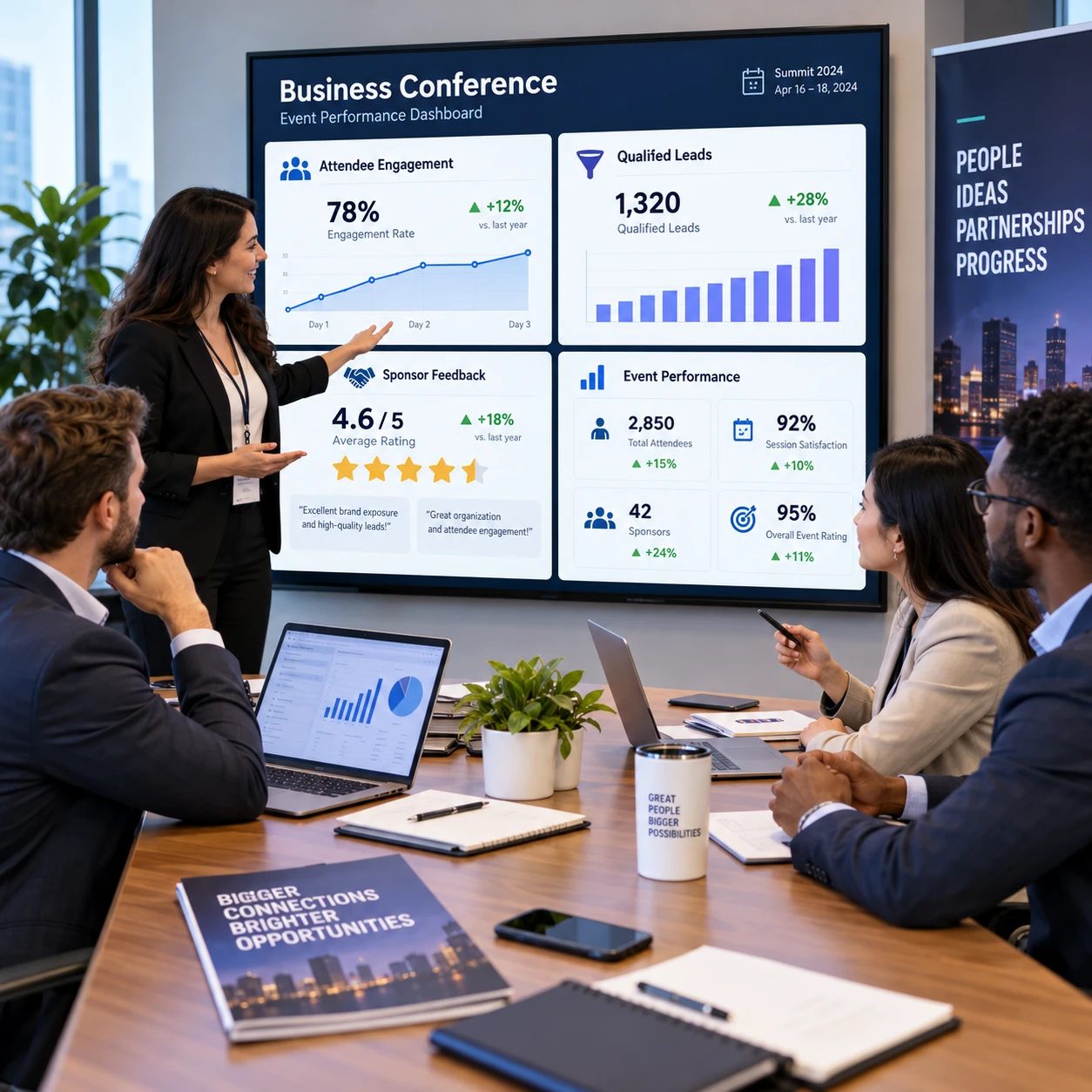
A high turnout can make a conference look successful, but attendance alone cannot show whether the right people took part, learned something useful, or created business opportunities. To measure B2B event success, connect a small set of indicators to your objectives, then review engagement, attendee experience, lead quality, sponsor value, and longer-term outcomes.
Start with clear event objectives
Clear event objectives determine which metrics matter and how you will judge success. Before setting targets, define what the conference or B2B event is meant to achieve, for whom, and within what timeframe.
An event focused on customer education needs different measures from one designed to generate sales conversations or strengthen an industry community. Choose a few outcomes rather than tracking every available data point. A useful test is whether each metric can help you make a decision.
- Demand generation: Set targets for qualified leads, meeting requests, and sales-accepted opportunities.
- Customer engagement: Track participation from existing customers, session engagement, and post-event feedback.
- Industry positioning: Measure attendance from priority roles or accounts, content reach, and meaningful interactions with speakers.
- Sponsor value: Agree on audience fit, quality conversations, and sponsor satisfaction before the event.
For each objective, record a baseline where possible, a target, a data source, and an owner. For example: “Generate 30 sales-accepted leads from target accounts, measured in the CRM within 30 days.” This is more useful than a broad goal such as “increase engagement.”
Measure attendee engagement and experience
Attendee engagement measures whether people actively participate and find value in an event. Combine session participation, interactions, content use, and feedback; no single signal captures the full experience.
Session participation can include registrations, check-ins, attendance duration, and questions asked. Compare these figures by session type and audience segment. A popular keynote may draw a large crowd, while a smaller workshop could generate more discussion or practical learning. Keep the distinction clear: a check-in shows presence, not attention or satisfaction.
Other useful indicators include:
- Poll responses, live questions, and participation in roundtables or workshops
- Visits to exhibitor booths, product demonstrations, or scheduled one-to-one meetings
- Downloads, video views, or repeat visits to event content, where tracking is disclosed and appropriate
- Attendee feedback on relevance, logistics, speakers, and likelihood to recommend or return
Use short surveys with specific questions, such as whether a session answered a practical need. Response rates can skew the picture, so compare feedback with participation data and note who did not respond. A valuable measure is engagement quality: whether the right attendees took part in the activities connected to your objectives.
Evaluate lead quality and sales impact
Lead quality and sales impact show whether event interactions can progress toward business outcomes. Track qualified leads, timely follow-up, conversions, and pipeline contribution instead of relying on badge scans or raw contact counts.
Agree on what counts as a qualified lead with the sales team before the event. Criteria might include a fit with your target account profile, relevant role, expressed need, and consent to follow up. A contact who scanned a badge at a booth is not automatically a sales-ready prospect.
Then connect event records to your CRM and define a follow-up process. Capture the interaction source, topic of interest, next step, and responsible owner. Measure:
- Lead quality: The share of captured contacts meeting the agreed qualification criteria.
- Follow-up execution: The share contacted within the agreed service window and the number of meetings booked.
- Lead conversion: Progress from event lead to sales-accepted lead, opportunity, and, where relevant, customer.
- Pipeline contribution: Opportunities associated with event interactions, reported with a clear attribution method.
Pipeline can take months to mature, and an event may influence a deal without being its sole cause. Separate sourced pipeline from influenced pipeline, document your attribution rules, and revisit results at agreed intervals. This avoids overstating impact while still recognizing the role of conversations and content in a longer sales cycle.
Track sponsor and exhibitor value
Sponsor and exhibitor value is best assessed through audience fit, meaningful engagement, and sponsor satisfaction. Count interactions, but also check whether those interactions reached the people and accounts sponsors wanted to meet.
Before the event, ask sponsors to specify their target audience and what they consider a useful outcome. Depending on the package and event format, relevant measures may include qualified booth conversations, booked meetings, demonstration attendance, or opt-in follow-up contacts. Share definitions so that organizers and sponsors do not interpret “lead” differently.
Afterward, collect structured feedback on audience quality, logistics, visibility, and the usefulness of lead data. Compare the feedback with attendance by role, organization, and account segment. A large number of booth visits may have little value if few visitors match the sponsor’s market.
Also review the cost and effort required to deliver each sponsorship benefit. Strong sponsor satisfaction can support renewals, but it should not replace evidence of audience fit or engagement. Report both activity and quality, and be transparent about limitations such as incomplete scans, overlapping sessions, or delayed sponsor follow-up.
Calculate event ROI in context
Event ROI compares relevant event costs with measurable outcomes, but the calculation depends on the event’s objectives, attribution rules, and timeframe. Use a consistent method, state what you included, and avoid treating early pipeline estimates as guaranteed revenue.
A common financial calculation is:
ROI = (attributable return − event cost) ÷ event cost × 100
The formula is simple; defining “return” is not. For a lead-generation event, you might report closed revenue linked to event-sourced opportunities. For a customer conference, value could include renewals or expansion, provided you can explain how the event contributed. Include relevant costs such as venue, production, travel, staffing, technology, and promotion. Use one approach consistently across comparable events.
Separate immediate results, such as qualified meetings, from outcomes that need time to develop, such as closed business or retention. Some benefits, including stronger customer relationships or industry learning, may be important but difficult to express as revenue. Report them alongside financial measures rather than forcing a weak monetary estimate. ROI is a decision aid, not a universal verdict on event quality.
Turn event data into improvements
Turn event data into improvements by comparing results with the original objectives, investigating gaps, and assigning specific changes for the next event. Review both the metrics and how reliably you collected them.
Schedule a post-event review while details are fresh, then return to business outcomes after the sales cycle has had time to progress. Bring together registration and attendance records, session participation, attendee feedback, sponsor reports, CRM activity, and costs. Segment results by audience type, session, account, or channel where the data supports a meaningful comparison.
A practical review asks three questions: What worked for the intended audience? Where did participants or leads drop out? Which result can be traced to an event decision? If a session drew interest but few attendees stayed, examine timing, format, or expectations before concluding that the topic failed.
Common measurement errors are avoidable:
- Using attendance as the success score: It is easy to count, but does not show relevance or business value. Pair it with engagement and outcome measures.
- Defining metrics after the event: Teams may then select whichever numbers look strongest. Set objectives, definitions, and data owners in advance.
- Counting every scan as a qualified lead: This inflates performance and frustrates sales. Agree on qualification criteria and record context.
- Judging pipeline too early: Long B2B sales cycles can make early reports incomplete. Set follow-up checkpoints and label results as provisional.
Finish with a short action list: keep what produced useful outcomes, change what created friction, and stop collecting data that does not inform a decision. That makes measurement part of event planning rather than a report prepared after the fact.